Wednesday, November 27, 2013


Hong Kong and Macau
Prior to 1997 the economic decisions of Hong Kong were made by Business Elites. Under China rule the "one country, two systems" refers to the unchanged democratization of Hong Kong and Macau. The CCP has promised not to change anything in Hong Kong for 50 years. Hong Kong is often described as a laisser-faire economy which means the state neither owns nor controls the means of production. The driving force behind Macau's economy is gambling while Hong Kong's main industry is producer services.
Urban China
Urban centers first started to appear in China during the Shang Dynasty, but it was during the Song Dynasty when cities changed from mostly administrative duties to centers of commerce. People were allowed to move freely between urban and rural China and many did so for work. This was called floating population. These rural residents that traveled to urban cities for work enjoyed a lot less of the opportunities and benefits than the people who lived in the urban cities. During the socialist era most of the Chinese city centers were political and administrative as well as economic centers. During the reform era more balanced development was sought. To have a greater balance between large, medium and small cities would be beneficial to the entire Chinese economy.Tuesday, October 22, 2013

China's Opening Process
China opening up its doors to the world has had a huge impact on its economy. The number of trade partners in the international market has increased, and along with that comes dramatic growth in the import and export business. Going away from the Autarky, pre-reform era, way of conducting business means a move in the right direction for foreign investors to move in and take advantage of cheap labor costs. This ultimately brings down the price of products returned to the retail markets in the United States.
China's Economy and Reforms
China has been working hard to change its image towards the world as a friendly place to conduct business. China is currently trying to get away from the Soviet Union economic model it emulated after CCP took power. The economic reforms put in place have allowed more foreign investments and trade to take place creating a far better economic environment for the people of China along with contributing to the global economy.
Population Geography
With an approximate current population of 1.3 billion, China and its economy is growing. Even thought China's current population growth is characterized as having a low birth rate, low death rate and a low growth rate, when you have a population over 1 billion a low growth rate is still growth. There has been attempts to slow down the population growth, like limiting the number of children one family could have. This is neither good for the people or for the economy. The population is seeing smaller groups of working age people due to this limitation which in the long run will harm the economy.Friday, September 27, 2013

The Political Geography of Emerging China
China views itself as being superior to the rest of the world both politically and economically. While the economic growth of the country has climbed rapidly toward the top of the list of world economies, its political relationship has not always followed suit. China's ethnocentrism has much to do with how the country is perceived economically by other countries. There were attempts to look beyond its own land for economic opportunities as early as the 8th century A.D., but by the late Ming times these maritime expeditions were halted because of high costs of maintaining the fleet and political instability. The results were a return to inward growth, population growth and stagnating per capita output.Monday, September 23, 2013
.jpg)
Ancient Roots and Binding Traditions
China has a long and complex history that has taken place on the diverse landscape of its extensive nation. While the roots of the Chinese economy started with overland trade and the Silk Road, it shifted to a very prosperous maritime trade. This new economic orientation not only changed how quickly and with whom the Chinese were able to conduct business from and international stand point, it also expanded the domestic economy by changing the core economic region of China from the interior of the country to the southern and eastern coasts. The ancient economic roots are established, but the branches of those roots are constantly growing and expanding.Saturday, September 21, 2013
China's Natural Environments
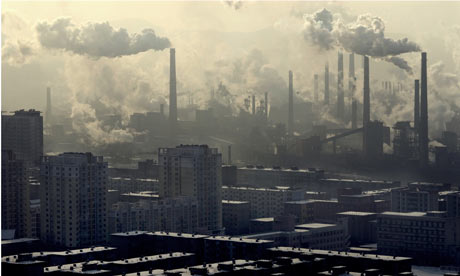
China is roughly the same size as the United States and only smaller than Russia and Canada. The difference between all these countries is China has to use its land and resources to support an economy with nearly one-fifth of the world population. It appears the grow the economy at any cost to the environment attitude has turned a corner in the first decade of the new millennium. The attitude of great prosperity and a booming economy can only come at the cost of the environment is finally looked at as bad by the very highest levels of government. The pollution, created by industry used to support such a booming economy, of the massive river system, and the deforestation is being viewed as unsustainable. While human interference and the upward climb of an advancing economy has played a huge role in China's environment, the future is looking less cloudy.

China's Path and Progress
China's current pace of economic development is climbing as fast as this flight of stairs leading to the temple on Tai Shan Mountain in Old China. The Chinese describe their economic system as socialism with Chinese characteristics. In 2012, China's Gross Domestic Product was ranked 2nd in the world. Thanks to a current population of 1.3 billion people, there is no shortage of a labor force in China. This abundance of labor helped quadruple the highway network, triple the rail freight system and increase economic growth at a rate of 8-10% per year from 1978 to 2008. China's economy moved away from agriculture and heavy industry towards light manufacturing and the service sector. China is changing rapidly whether anyone likes it or not. It is very important that we as a world begin to understand China's history as well as their path moving forward.
Subscribe to:
Posts (Atom)